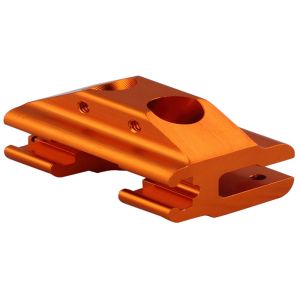
Product Description

Description
Aluminum alloys are alloys consisting of aluminum with other metal
elements such as copper, zinc and manganese. Aluminum is
characterized by light weight, good thermal conductivity, high
electrical conductivity, and excels in machinability and corrosion
resistance. Aluminum alloys have good plasticity and strength, can
be machined in a variety of shapes, and have high corrosion
resistance, making them suitable for use in the manufacture of
aircraft, automobiles, and ships.
In contrast, galvanizing is a surface treatment technique that
protects steel by coating it with a layer of zinc. Galvanizing
improves the corrosion resistance of steel and extends its service
life. The process of galvanizing is mainly divided into two types:
hot-dip galvanizing and electro-galvanizing. Hot-dip galvanizing is
the process of forming an alloy layer between the zinc and the
surface of the steel by immersing the steel in molten zinc at high
temperatures, while electro-galvanizing is the process of forming a
uniform layer of zinc on the surface of the steel through an
electrochemical reaction. Galvanized steel has good corrosion
resistance and is widely used in construction, bridges, electrical
equipment and other fields.
Applications
- Consumer Goods
- Unique architectural decoration and styling
- Dedicated heat sinks for advanced cooling systems
- Custom frames for solar panels and renewable energy systems
- Custom railing and construction project support
- Innovative design of consumer electronics enclosures
- Custom channels and tracks for industrial machinery
Customization is invaluable to industries seeking to optimize
product design to improve performance, durability or cost
effectiveness. It supports a wide range of applications from simple
to complex profiles, providing solutions not available with
standard extrusions.
Specifications
| Product | Material | Color | Surface treatment | Lead Time |
|---|
| Aluminium Extrusion Parts | AL2024, AL5052, AL6061, AL6063, AL7050, and AL7075 | Green, Grey, Black, White, (RAL series) etc. | Mill finish, anodized, electrophoretic coating, powder coating,
thermal break, wood grain/wood-in-shift, etc. | 1-2 weeks for sample, 2-5 weeks for bulk order |
Alloy Composition
| Alloy | Si | Fe | Cu | Mn | Mg | Cr | Zn | Ti | Impurity | Al |
|---|
| 6063 | 0.2-0.6 | 0.35 | 0.1 | 0.1 | 0.45-0.9 | 0.1 | 0.1 | 0.1 | 0.15 | Rest |
| 6061 | 0.4-0.8 | 0.7 | 0.15-0.4 | 0.15 | 0.8-1.2 | 0.04-0.35 | 0.25 | 0.15 | 0.15 | Rest |
| 6060 | 0.3-0.6 | 0.1-0.3 | 0.1 | 0.1 | 0.35-0.6 | - | 0.15 | 0.1 | 0.15 | Rest |
| 6005 | 0.6-0.9 | 0.35 | 0.1 | 0.1 | 0.40-0.6 | 0.1 | 0.1 | 0.1 | 0.15 | Rest |
Feature Advantage
Recyclability: Aluminum is 100% recyclable and retains its
properties during the recycling process, making it valuable from
both an economic and environmental perspective.
About Us


Q&A
Q-1. Why is extruded aluminum the preferred choice?
Aluminum is preferred due to its lightweight, strength, and
corrosion resistance, making it an ideal choice for various
applications.
Q-2. Can aluminum extrusions be recycled?
Yes! Aluminum profiles have a high level of recyclability, which
contributes to environmental sustainability.
Q-3. Is the aluminum profile cost-effective?
Given its durability and the efficiency of the extrusion process,
aluminum extrusions are an economical solution for many projects.
Q-4. How does the strength of aluminum extrusions compare to that
of steel?
Although steel is generally more durable, aluminum extrusions have
a better strength-to-weight ratio. Therefore, it is very suitable
for applications that prioritize weight.
Q-5. Can aluminum extrusions be customized?
Yes! One of the main advantages of aluminum extrusion is the
ability to create custom profiles for specific applications.
Q-6. Are there any limitations to using aluminum extrusions?
While versatile, aluminum extrusions may not be suitable for
applications with extremely high stress levels if the appropriate
alloy selection and design considerations are not made.